
Jordan Fengel is a member of the SWEEP Local Government Committee and is the Executive Director of the State of Texas Alliance for Recycling (STAR). Prior to joining STAR, Jordan managed the recycling program for the City of Georgetown, TX
This article serves as a guidance to government officials, planners, and recycling industry operators to provide the most up-to-date information regarding the lifespan of COVID-19 on inanimate objects and how to keep recycling services and facilities in operation and everyone involved safe.
These are unparalleled times for everyone. The rapid spread of the coronavirus, COVID-19, across the globe has caused many disruptions to our daily lives and sadly has led to the loss of life. As manufacturers and other entities produce and distribute a large variety of critical supplies needed across the nation, there must be continued public participation by the healthy population in recycling to provide feedstock to entities that use recycled content. Recycling during a pandemic is important. Safely managing materials is duly important.
What We Know: How Long the Virus Lives on Surfaces
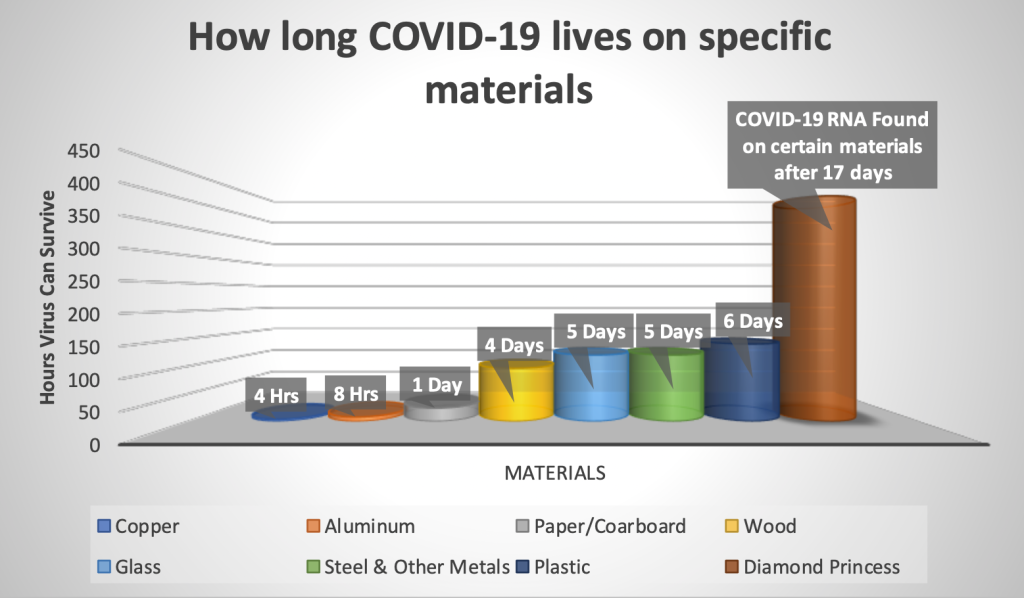
To date, studies show human coronaviruses can remain infectious on inanimate surfaces at room temperature for up to 9 days and at a temperature of 30° C [86° F] or more, though the duration of persistence is shorter.2 Human-to-human transmissions have been described with incubation times between 2-10 days, facilitating its spread via droplets, contaminated hands or surfaces.2 A recent investigation on the Diamond Princess cruise ship revealed that COVID-19 RNA was identified on a variety of surfaces in cabins of both symptomatic and asymptomatic infected passengers up to 17 days after cabins were vacated before disinfection procedures had been conducted.3
A recent study showed that COVID-19 lived on specific materials as follows:
- Steel and other metal: 5 days
- Copper: 4 hours
- Plastic: 6 days
- Aluminum: 8 hours
- Paper/cardboard: 24 hours
- Wood: 4 days
Though the study referenced above showed various lengths of viral stability on different materials that would enter the recycling stream, the research done on the Diamond Princess cruise ship showing viral activity for up to 17 days without disinfection is an important finding. To provide maximum safety to material management workers we will suggest that the timeframe of 17 days be used as the general rule-of-thumb regarding how long COVID-19 lives on various inanimate objects. During this time extra precautions should be taken with recycling and other materials managed during the COVID-19 pandemic.
OSHA Guidelines
OSHA guides that workers and employers should manage municipal (e.g., household, business) solid waste and recycling with potential or known COVID-19 contamination like any other non-contaminated municipal waste and recycling. Use typical engineering and administrative controls, safe work practices, and PPE, such as puncture-resistant gloves and face and eye protection, to prevent worker exposure to the material streams (or types of wastes), including any contaminants in the materials, they manage5. These types of measures can help protect workers from sharps and other items that can cause injuries, as well as exposures to multiple types of communicable substances.
What is Occurring
As many state and local governments act to “flatten the curve” to stop the spread of this virus by shutting down non-essential services and enacting shelter-in-place orders, residents are finding themselves at home generating increased amounts of solid waste and recycling materials. The materials coming from the homes of millions of healthy sheltered Americans, the bottles, cans, containers, boxes, cartons, and other resources that come from packaging and products, still need to be recycled.
However, due to concerns about worker exposure to the coronavirus, multiple municipalities across the nation are suspending recycling collection during the pandemic. Resource Recycling stated, “service changes have been reported, with operators citing concerns over the novel coronavirus spreading among employees or through interactions with customers. Programs have also cited concerns over employees handling potentially contaminated recyclables. Workforce shortages are adding additional pressure.” In Texas, the City of Temple, the City of Killeen, as well as the City of Mesquite as of March 23, 2020 have ceased the separate collection of recycling and are now diverting materials to the landfill with some of the reasoning behind the move being protection of workers from the exposure to the virus.
In already stressful and hazardous job settings, such as Material Recovery Facilities (MRFs), strict adherence to best management practices regarding the use of Personal Protective Equipment (PPE) including proper fitting filtration masks, gloves, and protective eyewear will provide workers with increased safety from illnesses and injury.
A key data point from the recent Diamond Princess cruise ship incident is that over 40 percent of the individuals who tested positive for COVID-19 were asymptomatic.7 This finding is relevant in that it points out that materials being managed by cities and recyclers could have been used by a “healthy” person who was unknowingly ill with COVID-19. It is important to recognize that workers are regularly exposed to pathogens and viruses daily. Both influenza A and B viruses survive for 24-48 hr on hard, nonporous surfaces such as stainless steel and plastic and less than 8-12 hr on cloth, paper, and tissues.8 There is a need for increased education and enforcement of workplace hygiene and safety and less of a worry about recyclables contributing to the community spread of COVID-19 or other illnesses and diseases. Following in-place measures and adhering to any updated guidelines will keep everyone involved safe.
While protecting the health and safety of workers handling potentially contaminated materials is vital, these considerations should not result in the suspension of recycling activities. Sustainable material management is crucial to our nations supply chain and the production of valuable items such as packaging, boxes, containers, and consumer goods. The best response to combat the spread of COVID-19 is proper use of PPE, thorough workplace and home hygiene, not venturing into public when ill and maintaining at least 6 feet distance between people if at work or if going outside the home is absolutely necessary.
The Need
As pointed out in a recent letter written to Vice President Pence by Robin Wiener of the Institute of Scrap Recycling Industries (ISRI), several of the manufacturing industries that recyclers frequently supply have been formally designated as part of America’s “Critical Manufacturing Sector” by the Cybersecurity & Infrastructure Security Agency (CISA), which is part of the Department of Homeland Security (DHS).
The CISA published a list of essential infrastructure sectors, a description that includes those providing “support to ensure the effective removal, storage, and disposal of residential and commercial solid waste and hazardous waste,” as well as “truck drivers who haul hazardous and waste materials to support critical infrastructure, capabilities, functions, and services.” Critical manufacturing sectors include iron and steel mills and ferro alloy manufacturing, alumina and aluminum production and processing, and nonferrous metal production and processing. The CISA description also encompassed, “workers who support the manufacture and distribution of forest products, including, but not limited to timber, paper, and other wood products.” According to CISA website, “The Critical Manufacturing Sector is crucial to the economic prosperity and continuity of the United States. A direct attack on or disruption of certain elements of the manufacturing industry could disrupt essential functions at the national level and across multiple critical infrastructure sectors9.”
ISRI highlights that recycling is a crucial first link in the manufacturing supply chain, supplying 40%, on average across all commodities, of the U.S. raw material needs10. Over three-quarters of U.S. paper mills utilize recovered paper from recycling companies for their daily production demands. Recyclers are responsible for supplying 58% of the feedstock to tissue mills throughout the United States, which are responsible for producing the toilet paper and tissues needed every day by citizens throughout the U.S. and which are currently in critical supply.11 In Texas, over 2.5 million tons of paper was collected and recycled in 2015 helping to contribute to the over $3.3 billion that recycling annually provides to the Texas economy.12 Companies like Pratt Industries and Smurfit Kappa, and others who produce critical shipping products rely on a steady supply of curbside recycled paper and cardboard for manufacturing. A supply chain cannot be stopped and resumed without significant supply disruptions that would ripple across the entire manufacturing chain.
Conclusion
Recycling during a pandemic should continue, but with extra attention paid to worker and public health and safety. There needs to be support for the continuance of recycling by healthy individuals and encouragement for cities and businesses to continue championing the collection and diversion of recyclables for use as a feedstock in manufacturing, especially in the face of a pandemic where there is a need to produce and distribute critical materials across the nation.
There are multiple key takeaways from the current pandemic event to keep front-line recycling workers healthy and the supply of vital recycled materials steady, and the main ones are simple to follow and are very effective:
- ensure proper use and adequate supply of PPE necessary to keep workers safe and able to continue operations
- provide a means for regular and thorough hand cleaning with soap and water for 20 seconds or an alcohol-based hand rub (minimum 60% alcohol content) if soap and water are not available
- enable and enforce good hygiene at work and encourage the practice at home
- educate about the importance of covering your mouth and nose with your bent elbow or tissue when you cough or sneeze. Then dispose of the used tissue immediately and wash hands
- encourage and support friends and family to not attend work or other social events/places when ill When communicating with workers about the potential lifespan of COVID-19 on recyclable materials we recommend stating it is known to survive 17 days on surfaces without disinfectant being used. With proper disinfection using 62-71% ethanol, 0.5% hydrogen peroxide, or 0.1% sodium hypochlorite solutions, the virus is defeated within 1 minute. A clean workspace combined with proper protective gear and frequent hand washing while encouraging employee healthiness can keep workers and employers safe during these times and any other day when managing materials. By not being around other people and places while ill, individuals can help prevent additional community sickness. This best practice pertains to common colds and flu and is just as effective at preventing COVID-19, the virus responsible for the global pandemic.
Author note: Information on COVID-19 is still developing, therefore, these data points and figures are subject to change. Advice for public. (n.d.). Retrieved March 23, 2020, from https://www.who.int/emergencies/diseases/novel – coronavirus-2019/advice-for-public
Are you committed to sustainability in materials management? Let SWEEP help you get certified and recognized for your efforts. Comment below, email [email protected], or head to https://lnkd.in/d6mQeTjC for more info.