
The interstate movement of solid waste has become an increasingly important component of the U.S. waste management industry, driven by the closure of smaller local landfills, consolidation of disposal capacity, growing private-sector ownership, and the economic advantages of transporting waste to large regional disposal facilities. What was once primarily a local business has evolved into an increasingly integrated national market, supported by extensive networks of transfer stations, trucking operations, rail transportation, and large-scale landfills.
According to Waste Business Journal estimates, the United States generated approximately 442.2 million tons of municipal solid waste (MSW) in 2025, equivalent to 7.1 pounds per person per day. Of this total, approximately 103.6 million tons, or 23%, was recovered, leaving 338.6 million tons requiring disposal. Including net international imports, total MSW disposal reached approximately 342.7 million tons, of which 94% was landfilled and 6% processed through waste-to-energy facilities.
Interstate waste shipments totaled approximately 58 million tons in 2025, an increase of 3.3% over the previous year. Total waste receipts from outside state boundaries, including international shipments, reached 65.15 million tons. Interstate and international waste movements now account for a significant share of the national disposal market, reflecting the growing dependence of major metropolitan areas on disposal facilities located beyond their borders.
Major Importing and Exporting States
Ohio remained the nation’s largest waste-importing state in 2025, receiving approximately 8.77 million tons, followed by Pennsylvania (7.89 million tons), Virginia (5.81 million tons), Michigan (4.05 million tons), Indiana (3.81 million tons), and Oregon (3.57 million tons). Together, these six states received approximately 33.9 million tons, representing 52% of all reported waste imports.
New York was the largest exporting state, shipping approximately 10.38 million tons to disposal facilities elsewhere, followed by New Jersey (7.61 million tons), Massachusetts (3.21 million tons), Illinois (3.15 million tons), Maryland, and Washington (3.01 million tons). The concentration of waste exports in the Northeast reflects the region’s limited landfill capacity, high disposal costs, and increasing reliance on facilities in other states.
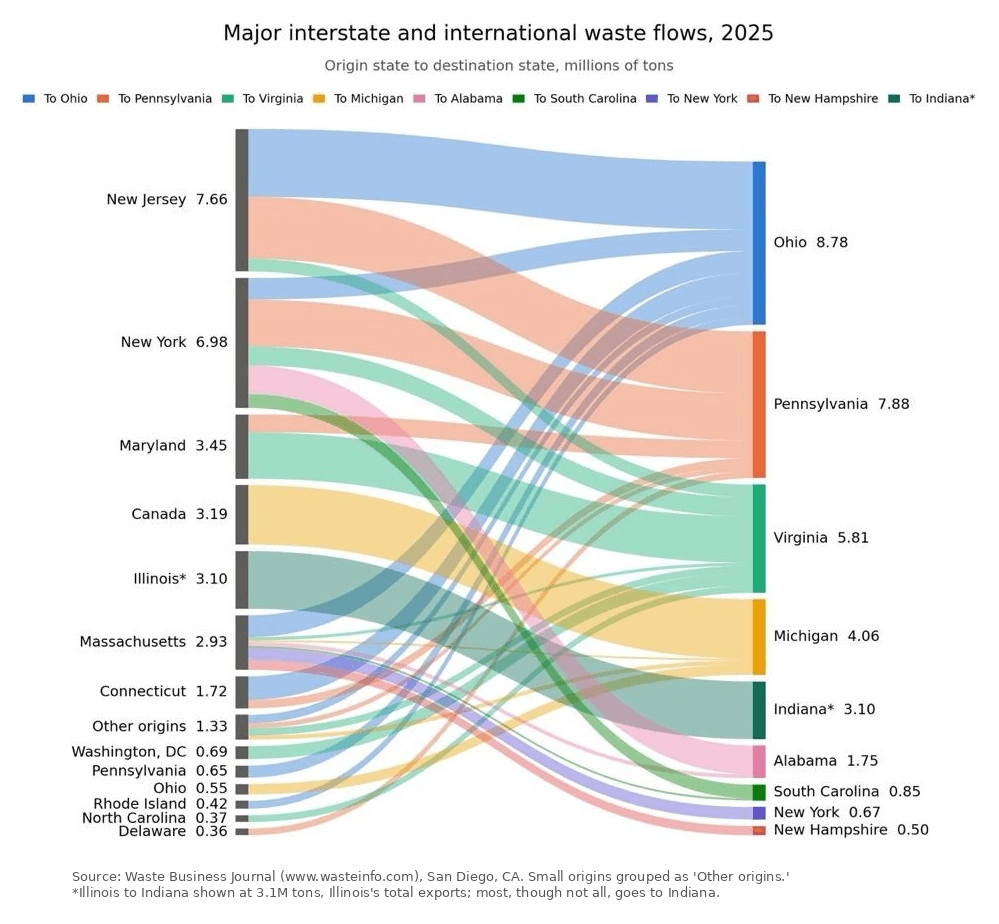
Figure 1: Major US Interstate Waste Flows
The largest waste transportation corridors include New Jersey to Ohio and Pennsylvania, New York to Pennsylvania and Alabama, Maryland to Virginia, and Washington to Oregon. International waste movements are also significant, particularly shipments from Canada to Michigan, which totaled approximately 3.19 million tons in 2025.
Concentration of Disposal Capacity
Interstate waste disposal is increasingly concentrated among a relatively small number of large facilities. In Ohio, three landfills—Apex Environmental, WIN Waste Seneca County, and Tunnel Hill—collectively received approximately 6.94 million tons of imported waste, accounting for nearly 79% of the state’s total. Pennsylvania’s Fairless Landfill alone received approximately 2.67 million tons, while Oregon’s Columbia Ridge Landfill accounted for approximately 88% of that state’s imported waste.
Major waste management companies, including WM, Republic Services, Waste Connections, Interstate Waste Services, and WIN Waste Innovations, have developed extensive transportation and disposal networks that allow them to serve markets hundreds of miles from their landfills. Their competitive advantages increasingly depend on permitted disposal capacity, access to rail infrastructure, transfer station networks, and long-term customer contracts.
Growing Importance of Waste-by-Rail
Rail transportation has become an important component of long-distance waste disposal, particularly for high-volume shipments originating in the Northeast and other densely populated metropolitan areas. Large rail-served landfills in Ohio, Pennsylvania, Alabama, and Oregon have expanded the geographic reach of disposal markets and enabled operators to achieve economies of scale that would be difficult to realize through trucking alone.
Although waste-by-rail requires substantial investments in transfer stations, railcars, terminal facilities, and related infrastructure, it can provide economic advantages for sufficiently large and consistent waste volumes moving over extended distances. The economics depend on transportation distance, terminal handling costs, disposal fees, and the reliability of rail service.
Market Outlook
Over the longer term, interstate volumes have grown for more than three decades: reported interstate imports rose from 17.1 million tons in 1995 to 42.2 million tons in 2005, and receipts from outside state boundaries reached about 65 million tons in 2025, although the earlier counts covered MSW only. Over the same period, receiving capacity has shifted from traditional importers such as Pennsylvania toward Ohio, Indiana and rail-served landfills as far away as Alabama and Oregon, while the Northeast has come to depend more on out-of-state disposal than ever.
Interstate waste movements are expected to remain an important feature of the U.S. solid waste industry as older landfills close, new disposal capacity becomes more difficult to permit, and large regional facilities compete for waste generated across increasingly broad geographic markets.
The continued concentration of disposal capacity, coupled with investment in transportation infrastructure, is likely to reinforce the competitive position of large, vertically integrated waste management companies. At the same time, landfill permitting constraints, transportation costs, regulatory developments, and local opposition to waste imports will continue to influence the direction and economics of interstate waste flows.
The fundamental trend is toward fewer, larger disposal facilities serving increasingly extensive geographic markets, with transportation infrastructure and access to permitted landfill capacity becoming critical determinants of competitive advantage.